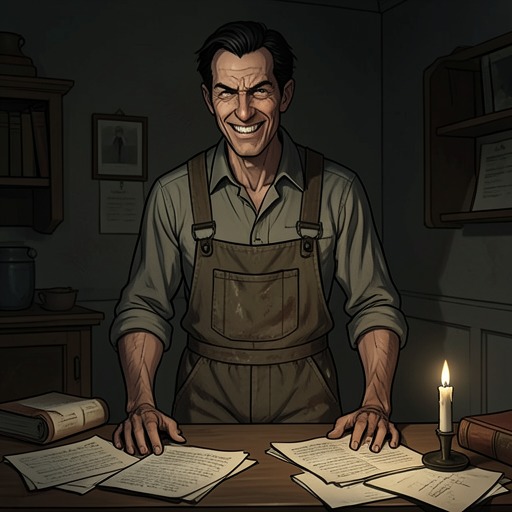
Gwynplaine’s disfigurement
The Man Who LaughsGwynplaine’s disfigurement is a deliberately produced facial difference that fixes a laugh on his face without making him joyful. The expression governs how strangers see and respond to him, while his feelings remain his own. That split sustains his career as a performer, exposes him to social rejection, and ultimately gives his body a public meaning far beyond the entertainment for which it was made.
Identity and Formation
The narrative first presents Gwynplaine’s face as something that cannot plausibly be explained by chance or ordinary natural variation. Its features seem arranged to produce a single, unmistakable effect: laughter. The account suggests that this appearance was fashioned through deliberate intervention when he was very young, and that his body was otherwise left intact. The contrast matters: the face that defines his public identity is not presented as an expression of his character, but as an imposed alteration.
The preparation of Gwynplaine for performance extended beyond his face. He was trained as a gymnast and athlete, and his flexible movements were adapted to a clown’s work. His hair had been dyed yellow and left rough in texture. These details place the disfigurement within a larger design: he was made into a performer, equipped to display a body and face that others could treat as a spectacle. The account imagines that his face had once been handsome, but presents that possibility as an inference rather than a remembered fact.
The Fixed Expression and Its Limits
Gwynplaine’s face appears to laugh continuously, but the laughter belongs to his appearance, not necessarily to his mind. His thoughts and emotions do not follow the expression written on his features. The smile cannot simply be removed; surprise, anger, pity, suffering, or tears can all intensify the same apparent hilarity. The result is a persistent mismatch between what he experiences and what observers believe they see.
There is one limited exception. By concentrating his attention and exerting his will, Gwynplaine can briefly suppress the fixed expression and cast his face into a more tragic appearance. The effort is extreme and difficult to sustain. Even a small distraction or emotional disturbance brings the grin back, with greater force after its temporary suppression. This qualification makes the expression more than a static mark: it is ordinarily beyond his control, yet the rare possibility of mastering it exacts an exhausting effort.
Performance and Social Response
As a mountebank, Gwynplaine turns the reactions his face provokes into a livelihood. Audiences laugh when they see him, and his spoken performance can send them into further laughter. His effect reaches across differences in mood and station: mourners try to avoid him lest they laugh against the gravity of their circumstances, while even an executioner is made to laugh. The response is described as powerful enough to draw people away from sadness, and Gwynplaine quickly acquires a reputation at fairs and crossroads.
A performance in which a sudden beam of light reveals his face produces an overwhelming reaction. Laughter spreads through the audience, and people in the street join in after hearing the crowd. Applause and stamping follow; Gwynplaine is called back, and the show becomes a popular success. Yet this public triumph does not mean that he is accepted as an ordinary person. The crowds come to laugh, and the account distinguishes that mass popularity from fashionable approval: the show costs a penny, and fashionable people do not attend. His face grants him a recognizable stage identity while keeping him marked as an object of spectacle.
The laughter also gives way to aversion. Once the initial comic effect passes, spectators turn away, and women in particular recoil from the sight of him. The public response therefore has two stages: an involuntary burst of amusement, followed by avoidance. His well-made, agile body contrasts with the face that dominates every encounter. What earns attention as entertainment also restricts how others can meet him—as a performer to laugh at or a figure to shun.
Public Meaning and Narrative Significance
The conflict between Gwynplaine’s inner life and outward appearance becomes especially painful when he speaks before the House of Lords. As he addresses the assembly about poverty and the suffering of those beneath the powerful, emotion rises in him and brings on uncontrollable laughter. The interruption turns his body against his intended speech: his words appeal for pity, while his face produces amusement. The assembly responds with renewed laughter, making his physical expression an obstacle to being heard at the moment he tries to speak for the poor.
Gwynplaine then makes the imposed smile part of his argument. He identifies himself both with his elevated status as Lord Clancharlie and with his former life among the poor, insisting that rank has not erased his earlier identity. He presents the laugh as something placed on him by a king and as a sign of forced silence, rage, and despair. In his account, his altered appearance figures a wider social deformation: just as his face has been made to display joy, a suffering people can appear cheerful while living under oppression. The crowd’s laughter at the speech thus repeats the very concealment he condemns.
The disfigurement consequently changes meaning across the narrative without ceasing to be a source of exclusion. In the fairground it draws an audience and sustains a performer’s reputation; in private feeling it masks what Gwynplaine actually experiences; in the House of Lords it becomes evidence in his indictment of power. The fixed smile is at once a condition imposed on one person and an image through which he makes public suffering visible. Its central irony remains that others laugh at a face whose owner does not control the laughter—and that the more seriously he tries to make them understand, the more readily they mistake his appearance for a joke.